borko tepina
Perception is not only because of something is there, but it is also because of something that is not there.
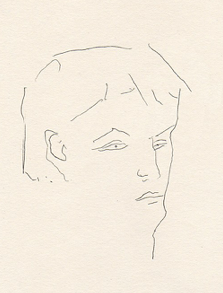
The condemnation onto the here and now, the continuity of time and space, has not been freed from the time when Leonardo dealt with. In our lives we still are dependent on it. There has always prevailed lack of awareness of anything that contributes to this, lack of the primal experience, instead to return to the most spatially and temporally elemental, with the highest attention to the field of creativity - and the visual art is one of the most basic ones, one of the most primal experiences to easily verify what we are doing.
Why? This experience begins with an observation, that at least initially, does not know any kind of alphabet, agreed real-world signs, and reading these must be rebuilt, upgraded, checked, verified every time anew. Leonardo could tell us a lot about this, despite the long temporal distance. The thought world knows some linear logic, but it does not work within the framework of the aesthetics. The Leonardo’s concept of continuity in the visible world, in contrast to the discontinuity of the verbal one, remained rather unimaginable in the area of the binary logic (black and white division between abstract/real, sensual/rational, material/ideological ...).
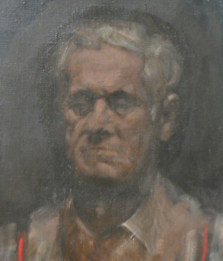
I take quite the opposite opinion of what is commonly thought that any reduction necessarily leads to the abstraction. Or, say that when eliminating the linear perspective, the painter leaves his medium. None of these theories holds true, which is especially relevant at a time when technical means are increasingly approaching near-perfect simulation of reality. Enough attentive observer will notice that the most sophisticated modern cameras are already avoiding complete simulation with the help of special algorithms that highlight those components of reality that make it as convincing as possible. The philosophy of observation is based on the fact that it always highlights something, at the expense of something else, disturbing, or less interesting. Reduction to a certain extent is therefore necessary. Paul Cézanne, the first to be well aware of this (in the context of modern art), was able to achieve internal autonomy through geometrization of shapes, while at the same time increasing of the contrast between them on the edges, While simplifying the observed bodies, it simultaneously sharpenes their edges, the point of contact, thereby enhancing their visual presence. Certain reduction of real did not, therefore, lead first to abstraction, to the loss of impression of the physical presence. And vice versa: impression of the physical presence was amplified by some reduction of the real.
While the music is possible to be recorded in eight tones and a few halftones, literature in twenty-five characters, despite the unimaginable amount of visual “characters” and virtually unlimited visual substance, or precisely for this reason, we like to avoid discovering the basic premise of art. At the first glance, with such a flood of visual stimuli, the artist does not have even roughly designed instruments for stacking pieces of art, some kind of “visual piano” with which he could construct or encode image with a special code system. Thus, it always remains in the field of implementation of something opaque, something that cannot be captured by any, even the most complex code system.
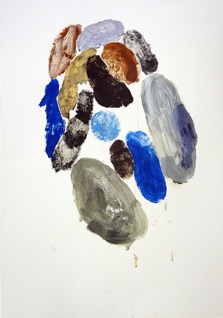
The painting, however, is at the very beginning a mixture of slippery, amorphous material, colored mixture, liquid, dust, clay, traditionally natural materials sometimes without any accurate name, that do not replace anything, or it is the material on its own, whose final effect is determined by an infinitesimally small (slight) touch. In doing so, we repeatedly encounter the problem of the visual alphabet (which nevertheless and even paradoxically still exists), of the sign system, which, however, somehow we must constantly build, upgrade, verify, define.
*
Johan Huizinga wrote that game was older than laugh. Mimicry is a very important form of the occurrence in wildlife, it is even older than game. It is also a special kind of game of nature, game of the outward appearance, an erroneous or correct assessment of visual appearance, which depends on the judgment of several and various observers. Which sometimes attracts, sometimes hides, sometimes threatens. An important agent of life, the survival, a form of an unwritten arrangement or deception in nature. One of the alphabets of (non)being, (un)anticipation, (un)expectation and (un)representation (or of the correct presentation?) among living creatures. Looks like art is pretty old, too.
Today, however, we may be increasingly afraid of saturation, dullness, powerlessness and disorientation, which is reflected both in the crisis of various social mechanisms, the flood of populism, the number of institutions, and the increasingly unmanageable aging of population. Also of moving, especially from poor places to the developed parts of the world, or when staying at home due to loss of their work.
That is why it is becoming so increasingly important how to give people hope, not only to individuals, but to all of the mankind. Not only does the threat of ecological catastrophe and the warming of the atmosphere hang in the air, but also the mass of population, the old and the young, the rich and the poor alike, which the immense amount of “instant gratification” offered by the media transforms into some kind of human plants. Consequently, they can only be “used” as consumers of hyper-productive industrial and information production.
The dice is a very important part of a game of chance. Its shape is crucial to its function as well, since a rolling dice actually implies a very tight connection between shape and its concept. It depends on itself, it does not appear as a sign. Design is crucial to its operation, to its concept. it emerges as a mere presence.
Parallel worlds, such as game and art worlds, require open observations, testing potential solutions, gaining experience, and learning to survive, not only symbolically, which can be well represented by a game of a young cat racing for a wool ball.
What is the connection between art and game? Identifying potential properties of emergent forms, including predicting new ones based on their genericity.